Three decades of adoption — without voting rights in Brussels
We've been part of the European Economic Area (EEA) since 1994. Through that agreement we have been adopting (or "adapting to") EU legislation for over three decades. The EEA-Lex database currently lists nearly 9,000 EU legal acts that have been incorporated into the EEA Agreement and taken effect in Iceland.
This means we are already bound by a large body of European laws and regulations, but because we stand outside the EU we have no representatives in the European Parliament or the Council of Ministers to vote on the laws when they are drafted and adopted.
What exactly has been adopted?
It is often said that Iceland has already adopted about 75% of EU legislation. This figure refers to the legislation that directly affects domestic law — regulations and directives concerning the economy, the labour market, and daily life (the acquis communautaire). This covers, among other things:
- The entire single market (free movement of goods, services, capital, and people).
- Competition and state aid rules.
- Financial services regulation.
- Energy, telecommunications, and transport.
- Public health, medicines, food, and animal welfare.
- Environmental protection, workplace safety, data protection, and consumer rights.
- Social policy, equality, and workers' rights.
What remains?
The remaining 25% falls into a few specific policy areas, sometimes called the "exceptions" of the EEA Agreement:
- The euro — adoption of the euro as currency.
- Fisheries — the EU's Common Fisheries Policy.
- Agriculture and rural development — the largest single block in terms of regulation. The EU's Common Agricultural Policy is extensive and we've never been part of it.
- The customs union and taxation — the common external tariff on the EU's outer borders vis-à-vis third countries; the harmonised VAT system.
- Justice and home affairs — although we already participate in Schengen cooperation on external borders, full membership would involve closer cooperation on policing and judicial matters.
We wouldn't be starting from scratch
If Icelanders decide in the referendum at the end of August to restart accession negotiations, we would not be starting from zero. The screening process from the last round of negotiations showed that Iceland already meets the entry requirements in most areas thanks to the EEA Agreement. The EU itself has confirmed that Iceland's accession process would technically be easier and faster than for most other candidate countries.
It's the politics — not the volume — that's the challenge
The question isn't really about the volume of legislation — it's about the political sensitivity of the remaining areas. Fisheries and agriculture are relatively limited in terms of the number of pages of legal text, but they carry enormous political weight in Icelandic politics and interest-group advocacy. Possible accession negotiations would be dominated by those two areas, plus the question of adopting the euro.
Sources and further reading:
- EEA-Lex database — the official EFTA register of EU acts incorporated into the EEA Agreement and their status.
- EFTA Surveillance Authority (ESA): Internal Market Scoreboard — performance assessment of EEA rule implementation in Iceland, Norway, and Liechtenstein.
- EUR-Lex: EU legislation summaries — the EU's legal information gateway with summaries of legislation in force.
- Ministry for Foreign Affairs: EEA advocacy and implementation — overview of Iceland's advocacy efforts in the EEA, transposition of acts, and the government's priority lists.
- Government of Iceland: EU accession referendum hub — official background page with links to screening reports and other documents from the 2010–2013 accession negotiations.
- European Commission: EU enlargement — Iceland — the Commission's overview of Iceland's accession process and the status of negotiations.
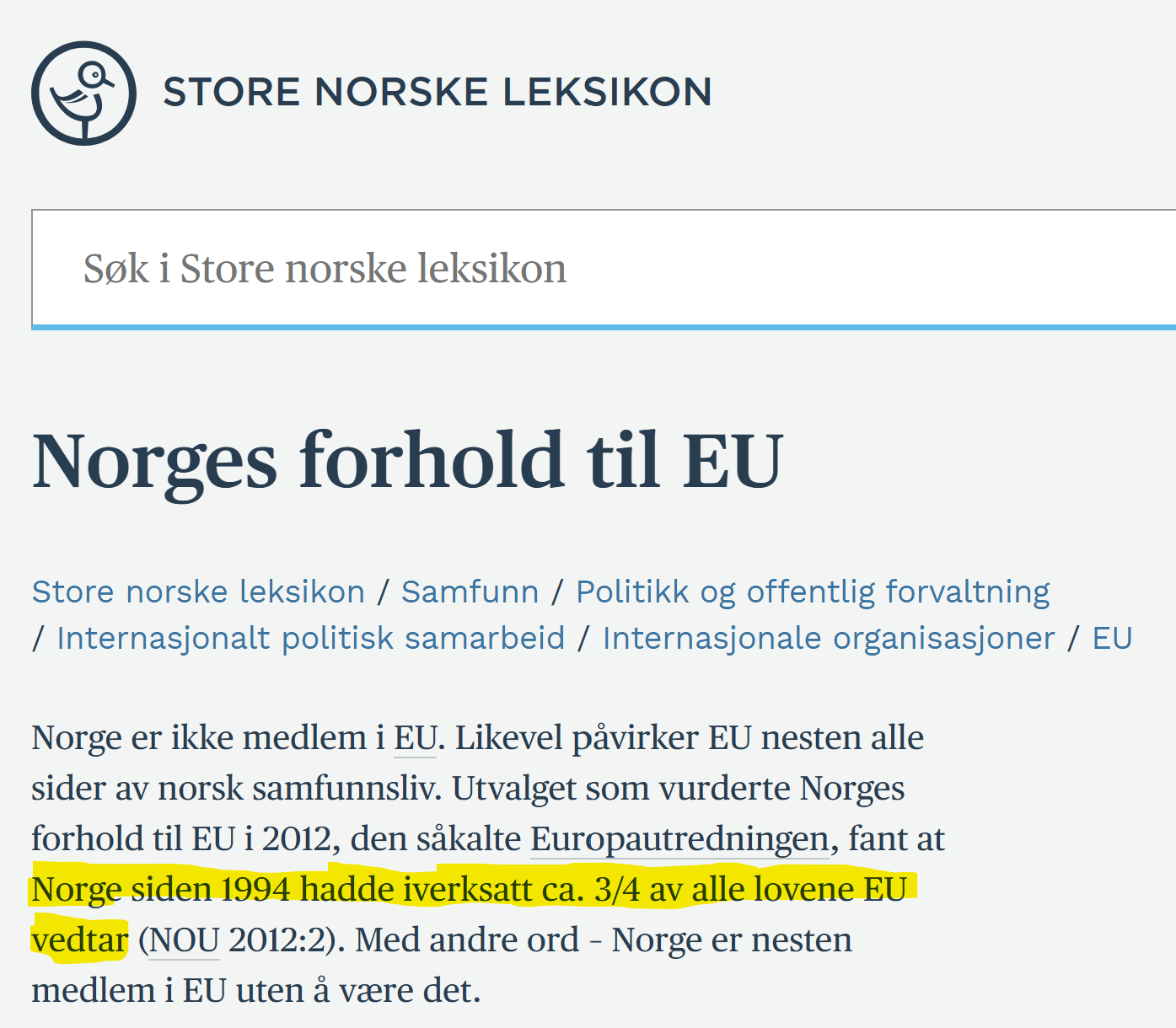
- NOU 2012:2 — Utenfor og innenfor: Norges avtaler med EU — the comprehensive Norwegian government review of Norway's EU relationship (the "Europautredningen"), which concluded that Norway — an EEA member like us — had adopted about three quarters of all EU legislation since 1994. See in particular pp. 18 and 790.
- Store norske leksikon: Norges forhold til EU — the Norwegian national encyclopedia summarises the review's conclusion, see screenshot:
 Click the image to see it at full size.